
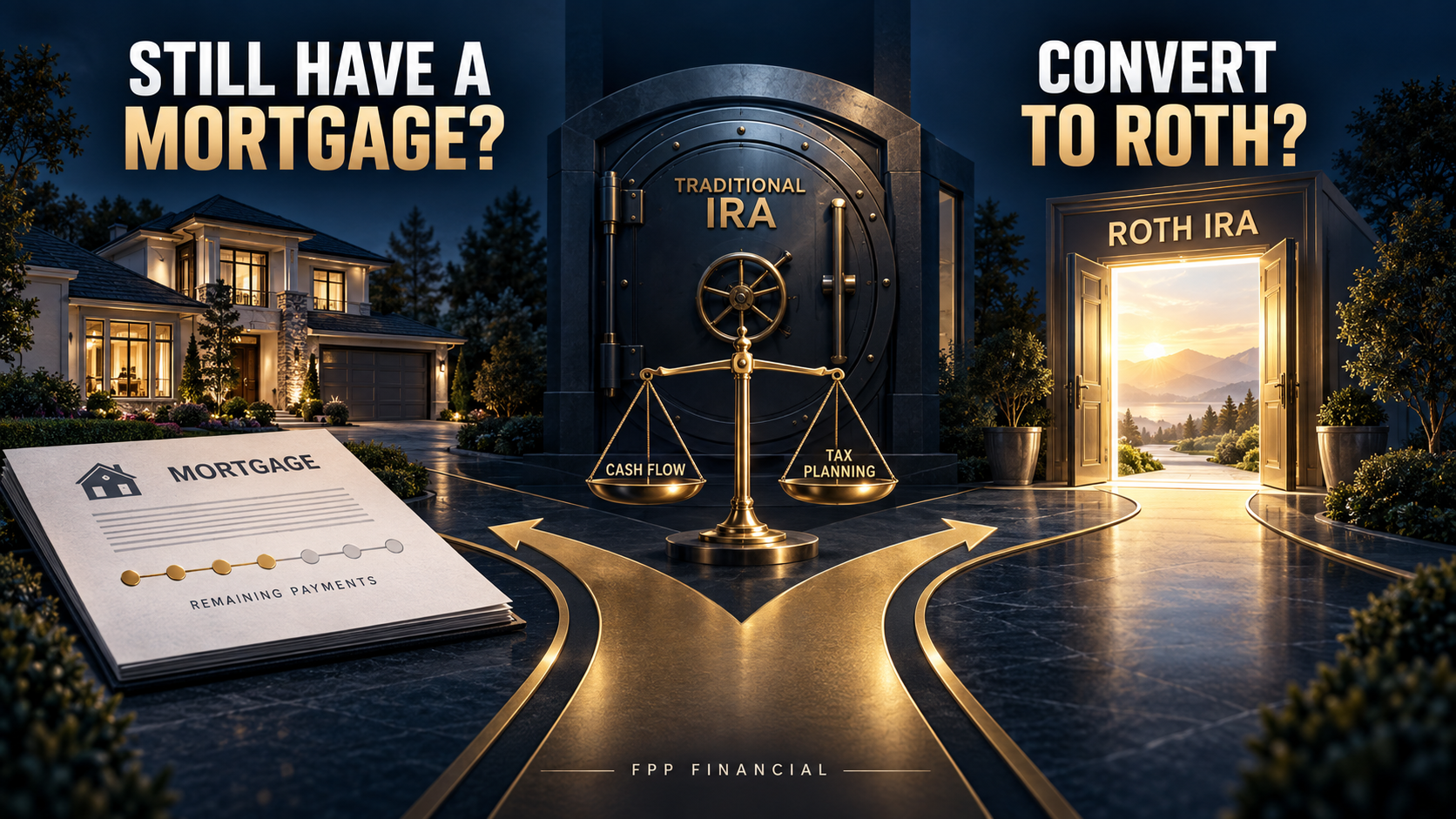
Should I Do a Roth Conversion If I Still Have a Mortgage in Retirement?
You’re 62.
You have $1.2 million in your traditional IRA.
You also have $250,000 sitting in savings and taxable investments.
And there’s still $180,000 left on the mortgage.
Now you’re thinking about a Roth conversion.
That’s when the same dollar suddenly has three jobs.
You could use your cash to pay down the mortgage.
You could keep the cash available for retirement.
Or you could use some of it to address the taxes created by a Roth conversion.
And you’re thinking:
“Which one actually puts us in a better position?”
That’s the right question.
Because paying off a mortgage can improve retirement cash flow.
A Roth conversion may improve future tax flexibility in a successful scenario.
And keeping cash gives you something neither strategy gives you:
Immediate liquidity.
The problem is that you can’t spend the same dollar three times.
Quick Answer: Can You Do a Roth Conversion If You Have a Mortgage?
Yes.
Having a mortgage doesn’t prevent you from converting eligible traditional retirement assets to Roth.
But your debt should be part of the analysis.
I would want to know:
- Your mortgage balance
- Your interest rate
- Your remaining loan term
- Your monthly payment
- Your available cash
- Your retirement income
- Your traditional retirement balances
- Your proposed conversion amount
- Your projected conversion tax
- Your future RMD exposure
- Your Social Security timing
- Your Medicare situation
- Your comfort level with debt
The Roth conversion doesn’t happen in isolation from the rest of your retirement balance sheet.
The Real Question Is Usually Bigger Than “Should I Convert?”
Suppose you have $200,000 available outside your retirement accounts.
You also have a $200,000 mortgage.
That makes the mortgage payoff look simple.
Write a check.
Debt gone.
But now your $200,000 cash reserve is gone too.
Or suppose you keep the mortgage and use $60,000 of that cash to address taxes from a Roth conversion.
Now you still have the mortgage, less cash, and more money in Roth.
Or you do neither.
You leave the traditional IRA alone and keep the cash.
Those are three completely different retirement strategies.
Example: $1.5 Million IRA, $200,000 Mortgage
Imagine you’re 63 and married.
You have:
- $1.5 million traditional IRA
- $300,000 in cash and taxable investments
- $200,000 mortgage
- Several years remaining on the loan
- Social Security planned later
- No immediate need for large IRA withdrawals
You want to retire now.
Your first instinct is:
“I want the house paid off before I stop working.”
That’s understandable.
But before sending $200,000 to the mortgage company, I’d want to compare what that decision does to everything else.
Strategy 1: Pay Off the Mortgage
This is the emotionally clean strategy.
No mortgage.
No principal and interest payment every month.
No debt hanging over retirement.
Your required monthly cash flow drops.
For some retirees, that peace of mind has real value.
But there is another side.
The money used to pay off the mortgage is no longer sitting in your bank or brokerage account.
You exchanged a liquid asset for additional home equity.
Your net worth may still look strong, but your accessible cash can fall dramatically.
A Paid-Off House Isn’t the Same as Cash
This is easy to forget.
Suppose you have:
- $800,000 home
- No mortgage
- $1.5 million IRA
- $75,000 cash
You may have substantial net worth.
But if you suddenly need $80,000 for healthcare, home repairs, a vehicle, or another major expense, the value of the house doesn’t automatically appear in your checking account.
You would need another way to access money.
Being debt-free and being liquid are not the same thing.
Strategy 2: Keep the Mortgage and Do the Roth Conversion
Now imagine you keep the mortgage.
Instead of using $200,000 to pay it off, you preserve part of your cash and use a portion to address taxes from a Roth conversion.
Maybe you convert $150,000.
Maybe $250,000.
Maybe smaller amounts over several years.
The traditional account becomes smaller relative to the no-conversion strategy.
The Roth becomes larger.
But you still have a monthly mortgage payment.
And some of your liquid cash has now left your control to address taxes.
The conversion may improve one part of the retirement while making another part feel tighter.
Strategy 3: Keep the Mortgage and Keep the Cash
This is the “do nothing yet” option.
No major mortgage payoff.
No large Roth conversion.
You maintain liquidity.
The traditional IRA stays where it is.
The mortgage continues.
This may feel conservative.
But doing nothing has consequences too.
The IRA can continue to grow or decline with its investments.
Applicable future RMDs remain part of the picture.
The mortgage continues costing interest.
Keeping every option open today can create different costs tomorrow.
Strategy 4: Split the Difference
This is often overlooked.
Maybe you don’t have to choose between:
“Pay off the entire mortgage”
and:
“Do the largest possible Roth conversion.”
You might model a partial mortgage reduction alongside smaller Roth conversions.
Or preserve a specific cash reserve first and allocate only the excess.
The goal isn’t to make every account look perfect.
The goal is to make the retirement work as a whole.
The Mortgage Interest Rate Matters
A retiree with a relatively low fixed mortgage rate faces a different decision from someone carrying substantially more expensive debt.
But I wouldn’t reduce the decision to:
“My mortgage rate is X, so anything earning more than X means I should keep the mortgage.”
That comparison can ignore:
- Investment risk
- Taxes
- Cash-flow needs
- Sequence-of-returns risk
- Liquidity
- Psychological comfort
- Future retirement income
Your mortgage payment is contractual.
Investment returns are not.
A retirement plan shouldn’t confuse an expected return with a guaranteed return.
What About the Mortgage Interest Tax Deduction?
Some homeowners may receive a federal tax benefit from qualifying mortgage interest when applicable requirements are satisfied and deductions are itemized.
Others may receive little or no incremental federal income-tax benefit from their mortgage interest.
Your tax professional should determine the actual tax effect in your situation.
Don’t keep a mortgage simply because someone told you:
“You need the tax deduction.”
You need the actual numbers.
Why Monthly Cash Flow Matters More After Retirement
When you’re working, a $2,000 mortgage payment comes out of a paycheck.
After retirement, that same $2,000 may need to come from:
- Social Security
- Pension income
- IRA withdrawals
- Investment income
- Cash reserves
That changes how the mortgage feels.
A retiree can have millions of dollars and still dislike watching a large fixed payment leave every month.
Reducing required monthly spending can create a kind of retirement flexibility that doesn’t show up in a tax bracket.
But Paying Off the Mortgage Can Create a New Problem
Imagine you’re 60.
You retire with $300,000 outside your retirement accounts.
You use $250,000 to eliminate the mortgage.
Now you have $50,000 of accessible assets.
Most of your wealth is tied up in:
- Your house
- Your traditional IRA
- Your 401(k)
Then the air conditioner fails.
You need a new vehicle.
You have a major medical expense.
Suddenly you’re taking additional money from retirement accounts because you don’t have enough cash.
Those withdrawals can have tax consequences.
Eliminating debt at the cost of eliminating liquidity can create a different retirement problem.
Now Add the Roth Conversion Tax
This is where the competing priorities become obvious.
You have $300,000 in accessible assets.
The mortgage payoff requires $200,000.
Your proposed Roth conversion may create a substantial tax obligation.
You can’t pretend both decisions have first claim on the same $300,000.
Maybe you can afford both.
Maybe doing both leaves you with too little liquidity.
Maybe the conversion amount needs to shrink.
Maybe the mortgage payoff needs to wait.
Maybe both need to happen gradually.
What If You Pay Off the Mortgage From Your IRA?
Be careful.
Suppose you owe $200,000 on your house.
You decide to take $200,000 from a traditional IRA and send it to the mortgage company.
A taxable traditional IRA distribution generally creates taxable income to the extent the distribution consists of taxable amounts.
So the amount needed to eliminate a $200,000 mortgage may not produce a simple $200,000 economic result after taxes and other potential consequences.
“I have enough in my IRA to pay off the house” is not the same as “I have enough after-tax money to pay off the house.”
What If You’re Under 59½?
Additional rules may matter.
Taxable retirement distributions before age 59½ can potentially be subject to an additional federal tax unless an exception applies.
That makes using traditional retirement assets to eliminate a mortgage before 59½ something that deserves careful tax review.
Roth conversions have separate rules and should not be confused with simply taking retirement money and spending it.
What If You Have a Very Small Mortgage?
Suppose you owe $40,000.
You have $500,000 outside your retirement accounts.
Paying it off may have almost no effect on your overall liquidity.
That’s a very different decision from someone owing $300,000 with only $350,000 available outside retirement accounts.
The mortgage balance matters relative to the rest of your financial life.
What If You Have a $500,000 Mortgage?
Now the debt may dominate retirement cash flow.
Maybe you downsized late.
Maybe you bought a retirement home.
Maybe you refinanced.
Maybe you live in a high-cost area.
A large mortgage doesn’t automatically mean Roth conversions are wrong.
But it can make preserving liquidity and reliable retirement income more important.
The conversion needs to compete against those needs.
What If the Mortgage Is Almost Paid Off?
Maybe you have three years left.
Now another strategy appears:
Keep making the scheduled payments.
Allow the mortgage to disappear naturally.
Use the available cash for other retirement priorities.
That may produce a different result from writing one large check today.
Should You Pay Off the Mortgage Before Social Security?
Maybe your plan is to retire at 62 but delay Social Security.
During those years, the mortgage increases the amount of cash you need from investments.
Paying it off could reduce that required withdrawal amount.
But using a large amount of cash for the payoff could reduce the assets available to fund the bridge to Social Security.
Lower monthly expenses don’t automatically mean greater liquidity.
Should You Convert Before Social Security?
Those same years may also be attractive for Roth conversion planning.
Now the mortgage and Roth strategy are competing during the exact same window.
You may have:
- No salary
- No Social Security yet
- No applicable RMDs yet
- A mortgage
- A large traditional IRA
- Finite cash reserves
That’s why I want the whole bridge period modeled.
What Happens When RMDs Begin?
Suppose you keep the mortgage and don’t convert.
Your traditional retirement account remains substantial.
Later, applicable RMDs begin.
Now the household may have:
- Social Security
- Pension income
- RMDs
- Mortgage payments
- Other living expenses
The RMD may provide cash that can help cover spending.
But it can also increase taxable income.
That’s another future scenario worth comparing with earlier Roth conversions.
What If Your Mortgage Continues Into Your 70s?
This isn’t automatically a disaster.
But it changes your fixed-expense floor.
You have less flexibility to cut spending during a bad market because the mortgage company still expects its payment.
That can make reliable income and adequate reserves more important.
Debt in retirement isn’t just a balance-sheet issue. It’s a monthly cash-flow commitment.
The Emotional Side of a Mortgage in Retirement
For some people, debt barely bothers them.
For others, it keeps them awake.
You spent your entire working life believing retirement meant:
“The house is paid off and nobody can take it away from us.”
Now someone is telling you the math may favor keeping a mortgage.
Even if the spreadsheet supports it, you may hate the strategy.
That matters.
A retirement plan you resent every month isn’t automatically a good plan just because the projection looks better.
“We Should Be Able to Handle This Ourselves”
You may have paid bills and managed money together for 35 years.
You think:
“We should be able to handle this ourselves.”
And maybe you can.
But the decision now involves more than paying down debt.
You’re balancing taxes, retirement accounts, future RMDs, Social Security, Medicare, liquidity, and housing.
Running those numbers doesn’t take control away from you.
It gives you more information before you decide.
“What If We Mess This Up and Regret It?”
This is the fear underneath both decisions.
If you pay off the mortgage, you worry you’ll regret giving up the cash.
If you keep the mortgage, you worry you’ll regret carrying debt into retirement.
If you do the Roth conversion, you worry you’ll regret paying the tax.
If you don’t convert, you worry future taxes and RMDs will make you wish you had.
“What if we mess this up and regret it?”
That’s exactly why the alternatives need to be compared before you commit.
“I Don’t Want to Ask My Kids for Help”
This is where liquidity becomes emotional.
You don’t just want a high net worth.
You want enough accessible money to handle your own life.
A roof.
A vehicle.
Healthcare.
A family emergency.
You think:
“I don’t want to ask my kids for help.”
So before using $200,000 to pay off the mortgage or $80,000 to address conversion taxes, we need to know what remains afterward.
Your independence needs a cash reserve.
What About the Surviving Spouse?
This is another reason mortgage planning matters.
Suppose one spouse dies.
The survivor may have:
- One Social Security benefit instead of two
- A mortgage payment
- Traditional retirement accounts
- Future RMDs
- Healthcare expenses
- Home maintenance
Would the surviving spouse feel better with no mortgage?
Or with a larger liquid reserve?
Maybe the answer is both, which means the plan needs to work toward both over time.
Should You Use Every Available Dollar to Become Debt-Free?
I wouldn’t assume that.
Retirement liquidity has value.
You can’t predict every expense.
And once cash is used to pay down the mortgage, accessing the home’s equity later may require selling, borrowing, or another financial transaction.
Debt-free isn’t the only definition of financially secure.
Should You Ignore the Mortgage and Convert Aggressively?
I wouldn’t assume that either.
A large conversion can create a significant current tax obligation.
If you use outside cash to address it while keeping a large mortgage, you may end up with:
- Less cash
- The same mortgage payment
- More Roth assets
- Lower traditional assets
Maybe that’s the projected winner.
Maybe it’s not.
But you should know before doing it.
How Can the Roth Conversion Tax Be Addressed?
When you have a mortgage, every method needs to be evaluated against liquidity and monthly cash flow.
Option 1: Outside Cash or Taxable Assets
Outside assets may be used to address taxes generated by Roth conversions.
This can allow more of the selected conversion amount to reach or remain inside the Roth.
But that cash may also be available to pay down the mortgage, cover mortgage payments, or serve as an emergency reserve.
The opportunity cost matters.
Option 2: Retirement Assets or Withholding
Another approach may involve retirement assets or withholding.
This can reduce the amount ultimately reaching or remaining inside the Roth and may create additional tax considerations.
The transaction mechanics should be coordinated before converting.
Option 3: Contractual Carrier Bonus Value
When suitable, certain annuity contracts may provide contractual carrier bonus value that can be included in the broader economic comparison.
In some modeled scenarios, contractual carrier bonus value may economically offset some or potentially all of the conversion-tax cost over the strategy period.
This may potentially reduce the need for additional personal out-of-pocket cash from an overall economic standpoint.
The carrier does not assume your IRS tax liability.
A carrier bonus isn’t an IRS tax credit.
Your tax remains your responsibility.
Bonus terms, vesting, surrender provisions, liquidity restrictions, charges, participation rates, caps, spreads, crediting methods, income features, guarantees, and other contractual provisions need to be evaluated.
This Is Where Roth Blueprint Software Comes In
The mortgage doesn’t belong in one conversation while the Roth conversion happens in another.
They compete for the same retirement dollars.
Using our Roth Blueprint software, we can assess thousands of potential modeled scenarios and compare the Roth conversion strategy with the rest of the retirement picture.
What Can We Compare?
We can assess different:
- Mortgage assumptions
- Retirement spending
- Outside liquidity
- Traditional retirement balances
- Roth balances
- Conversion starting years
- Annual conversion amounts
- Multi-year conversions
- Variable annual conversions
- No conversion
- Projected conversion taxes
- Different approaches to addressing conversion taxes
- Social Security timing
- Pension income
- Investment income
- Potential Medicare considerations
- Projected RMDs
- Surviving-spouse outcomes
- Beneficiary outcomes
- Legacy outcomes
Then we put the alternatives side by side.
Example: Make the Mortgage and Roth Strategies Compete
Imagine you’re 62.
You have:
- $1.4 million traditional IRA
- $300,000 outside assets
- $180,000 mortgage
- No pension
- Social Security planned later
- Retirement beginning this year
We might compare:
Scenario A: Keep the mortgage and do no Roth conversion.
Scenario B: Pay off the mortgage and do no Roth conversion.
Scenario C: Keep the mortgage and use some outside cash to address taxes from smaller Roth conversions.
Scenario D: Keep the mortgage and use larger multi-year Roth conversions.
Scenario E: Partially reduce the mortgage while doing smaller conversions.
Scenario F: Preserve a defined cash reserve first, then allocate remaining available assets based on the modeled result.
Then we look at:
- Monthly retirement cash flow
- Accessible assets
- Projected taxes
- Traditional balances
- Roth balances
- Future RMDs
- Retirement income
- Potential Medicare considerations
- Surviving-spouse outcomes
- Legacy
Now we’re answering the real question: What should these dollars do for your retirement?
The Retirement Math Method™
This is why we use our Retirement Math Method™.
I don’t start with:
“Always pay off your mortgage before retirement.”
I don’t start with:
“Never pay off cheap debt.”
And I don’t start with:
“Use your cash for Roth conversion taxes because Roth is better.”
Those are rules of thumb.
I want the strategies to compete.
Maybe paying off the mortgage wins.
Maybe keeping the mortgage and converting wins.
Maybe a smaller conversion protects more cash.
Maybe a partial mortgage payoff produces the balance you prefer.
Maybe preserving liquidity wins.
Maybe a multi-year conversion strategy wins.
Maybe doing nothing wins.
I don’t try to sell you on the strategy. I make the strategy prove itself with the math.
Let the math do the talking.
Frequently Asked Questions About Roth Conversions and Mortgages
Can I do a Roth conversion if I still have a mortgage?
Yes. A mortgage doesn’t prevent an eligible Roth conversion. The debt, monthly payment, interest rate, liquidity, conversion tax, retirement income, and future tax picture should be considered together.
Should I pay off my mortgage or do a Roth conversion?
There isn’t a universal answer. Paying down the mortgage and completing a Roth conversion use capital differently and can produce different effects on taxes, monthly cash flow, liquidity, future RMDs, and retirement assets.
Should I use savings to pay off the mortgage before converting?
That may reduce monthly expenses but also reduces liquid assets. The amount of cash remaining after the payoff should be considered before committing the money.
Should I use my IRA to pay off my mortgage?
A taxable traditional IRA distribution can create taxable income and may have additional consequences based on age and circumstances. The after-tax cost should be calculated before using retirement assets to eliminate debt.
Can I use cash to address Roth conversion taxes instead?
Potentially. Outside cash can be used to address conversion taxes, but doing so reduces accessible reserves and means that cash is no longer available for mortgage reduction or other retirement needs.
Does mortgage interest reduce the cost of keeping my mortgage?
Qualifying mortgage interest may provide a federal tax benefit for some taxpayers who satisfy applicable requirements and itemize deductions. The actual benefit should be determined using your individual tax situation.
Does paying off my mortgage reduce retirement spending?
It can eliminate principal and interest payments, but property taxes, insurance, maintenance, association fees when applicable, and other housing expenses generally remain.
What if my mortgage rate is low?
A lower fixed rate can affect the economic comparison, but investment risk, taxes, liquidity, monthly cash flow, retirement income, and personal comfort with debt should also be considered.
What if I don’t need my IRA for the mortgage?
If outside income and assets cover the mortgage, your traditional IRA may remain largely untouched. That can make projected future balances and RMDs worth modeling.
Can Roth Blueprint compare mortgage and conversion strategies?
Our Roth Blueprint process can assess thousands of potential modeled Roth conversion scenarios alongside retirement spending, liquidity, income, projected taxes, RMDs, Medicare considerations, surviving-spouse outcomes, beneficiary outcomes, and no conversion.
Your House, IRA, and Cash Are All Part of the Same Retirement
It’s tempting to put them in separate boxes.
The mortgage goes in the debt box.
The IRA goes in the retirement box.
The cash goes in the emergency-fund box.
But when you retire, all three affect the same thing:
Your ability to live the life you want without running out of flexibility.
Paying off the house may help.
A Roth conversion may help.
Keeping more cash may help.
The right answer is the combination that produces the retirement outcome you actually prefer.
Still Have a Mortgage and $500,000+ in Tax-Deferred Retirement Assets? Let’s Run the Math.
If you’re approaching retirement with a mortgage and $500,000, $750,000, $1 million, $2 million, or more in traditional IRAs, 401(k)s, or other tax-deferred retirement assets, don’t make the mortgage and Roth decisions separately.
When you meet with me, we can use our Roth Blueprint software and Retirement Math Method™ to assess thousands of potential modeled scenarios.
We can compare:
- No Roth conversion
- Mortgage payoff scenarios
- Keeping the mortgage
- Smaller annual conversions
- Larger annual conversions
- Multi-year conversions
- Variable annual conversions
- Projected conversion taxes
- Different approaches to addressing conversion taxes
- Retirement spending
- Personal liquidity
- Social Security timing
- Pension income
- Potential Medicare considerations
- Projected traditional balances
- Projected Roth balances
- Projected RMDs
- Retirement income
- Surviving-spouse outcomes
- Beneficiary outcomes
- Legacy outcomes
Then we put the strategies side by side.
Maybe paying off the mortgage wins.
Maybe keeping the mortgage and converting wins.
Maybe a smaller conversion protects more liquidity.
Maybe a partial payoff creates the balance you want.
Maybe keeping more cash wins.
Maybe doing nothing wins.
That’s what you want to know before using hundreds of thousands of dollars that may need to support you for the rest of your life.
We don’t sell you a retirement strategy. We run the math and let you decide.
Let the math do the talking.
Schedule Your Roth Conversion Strategy Appointment
Explore More
Should I Use Savings to Pay Taxes on a Roth Conversion?
Should I Use My IRA Money to Pay Taxes on a Roth Conversion?
Should I Do a Roth Conversion If I Don’t Need My RMDs?
Important Disclosure
This article is for educational purposes only and isn’t intended as individualized tax, legal, accounting, investment, lending, mortgage, insurance, Medicare, Social Security, estate-planning, or retirement-planning advice. FPP Financial does not provide tax or legal advice. Roth conversions generally create taxable income to the extent converted amounts would otherwise be taxable. Qualified Roth IRA distributions are generally tax-free under current federal rules when applicable requirements are satisfied. Traditional retirement-account distributions can create taxable income, and distributions before age 59½ may potentially be subject to an additional federal tax unless an exception applies. Mortgage-interest deductibility depends on current tax law and individual circumstances, including applicable requirements for itemized deductions. Paying off a mortgage reduces principal and interest obligations but doesn’t eliminate property taxes, homeowners insurance, maintenance, association fees when applicable, or other housing expenses. Using outside cash to pay down debt or address Roth conversion taxes reduces liquidity and may affect a retiree’s ability to address future expenses. Investment returns aren’t guaranteed and shouldn’t be treated as equivalent to contractual mortgage costs. Taxable Roth conversion income can affect federal and state income taxes, marginal tax rates, the federal calculation determining how much of Social Security benefits is included in taxable income, Medicare premiums, estimated tax requirements, liquidity, beneficiary outcomes, and other parts of a financial plan. Required minimum distribution starting ages and rules vary based on birth year, account type, beneficiary status, and current law. An RMD isn’t eligible for Roth conversion. Roth conversions can potentially reduce future traditional retirement-account balances and future RMDs relative to an otherwise identical no-conversion scenario, but no specific tax, mortgage, investment, Medicare, Social Security, RMD, retirement-income, surviving-spouse, beneficiary, liquidity, or legacy outcome is guaranteed. Tax laws, mortgage rules, interest rates, Social Security rules, Medicare rules, retirement-account rules, estate rules, beneficiary rules, housing expenses, and investment values can change. Roth Blueprint calculations and other projections are based on assumptions and information entered into the analysis and aren’t guarantees of future tax results, mortgage outcomes, account values, investment performance, retirement income, Medicare premiums, Social Security outcomes, RMD reductions, surviving-spouse outcomes, beneficiary outcomes, legacy results, liquidity, or product performance. Insurance and annuity products may contain fees, charges, surrender periods, liquidity restrictions, eligibility requirements, bonus provisions, participation rates, caps, spreads, crediting methods, income features, guarantees, and other contractual terms. Guarantees are subject to the claims-paying ability of the issuing insurer. A carrier bonus isn’t an IRS tax credit and doesn’t transfer the client’s tax liability to an insurance company. Statements that contractual carrier bonus value may economically offset some or potentially all of a modeled conversion-tax cost aren’t statements that the tax disappears or that the carrier directly pays the client’s tax liability. Before completing a Roth conversion, paying off or refinancing a mortgage, taking retirement distributions, using outside assets to address taxes or debt, purchasing an insurance or annuity product, or making other retirement decisions, consider working with qualified tax, legal, accounting, financial, investment, lending, mortgage, insurance, Medicare, Social Security, estate-planning, and other appropriate professionals who can evaluate your individual circumstances.


